
Besides the Navajo, the Zuni are a Native American people of western New Mexico. They call themselves the A:shiwi, and their home the Middle Place, Halona Idiwan’a. The Pueblo of Zuni lies about 34 miles south of Gallup, and the tribe numbers roughly 10,000 people. They are a Pueblo people whose culture is associated with the Mogollon and Ancestral Pueblo traditions.
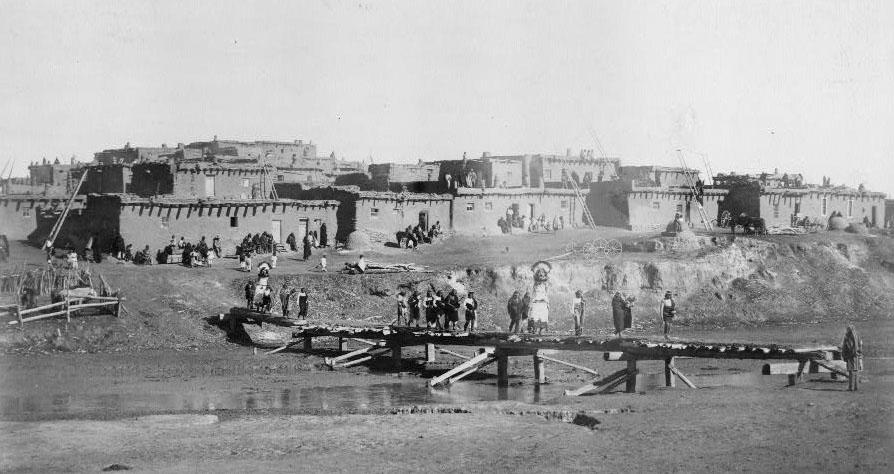
Highly interesting to visit: Pueblo of Zuni
The Zuni have lived in this homeland for a very long time, and their language is remarkable in its own right: Zuni is a language isolate, with no established relationship to any other language on earth. Linguists have suggested the Zuni have kept it distinct for six to seven thousand years.
Their neighbors took different paths with the same materials. The Hopi developed silver overlay, while the Navajo worked heavier silver with bold single stones.
The Zuni people were among the last groups of Native Americans to become Christian converts. It occurred after European contact when missionaries came into the area in the 19th century.
The Zuni Tribe Today
The Pueblo of Zuni is a sovereign nation with its own elected government. It is a separate people and a separate government from the Navajo Nation, whose much larger territory lies to the north and west – a distinction worth making, because the two are often confused. The Zuni also hold trust lands in Catron County, New Mexico, and in Apache County, Arizona.
Geography: The main community is Zuni Pueblo in McKinley County, western New Mexico, with the reservation extending around it. Most Zuni people live there rather than dispersed across the Southwest.
The reservation covers a little over 700 square miles. Alongside homes and farmland it supports a school system, a health center, and the studios and workshops that a community of working artists needs.
Zuni – Religion, Culture, Government & Language
Religion: Zuni ceremonial life is organized around kivas, medicine societies and an annual cycle of ceremonies, and it remains central to the community. Some Zuni are also Catholic, a legacy of Spanish missions from the sixteenth century onward. As with the Hopi, much of this is private, and visitors are asked to respect restrictions on photography and on attendance.
Culture: The Zuni are known above all as artists. A very high proportion of households include a working silversmith, lapidary, carver or potter, and the arts are a real part of the local economy rather than a sideline.
Government: The Zuni tribe people living on New Mexico’s reservation and their Navajo counterparts have their own elected governments. They are run separately from the Navajo government.
Language: Zuni, or Shiwi’ma, is still spoken at Zuni Pueblo and is taught to children, though like every Native language in the United States it is under pressure from English. Because it is an isolate, it cannot be learned by way of a related language – if it is lost, there is nothing else like it.

Zuni jewelry is among the most recognisable and technically demanding work in the Southwest, and it is built on lapidary skill rather than heavy silver. Zuni silversmiths are known for needlepoint, in which small oval stones pointed at both ends are set in individual bezels; petit point, where each stone is pointed at one end and rounded at the other; and mosaic and channel inlay, in which stones are fitted precisely into silver compartments. A single piece can carry dozens or hundreds of individually cut and matched stones.
Because Zuni work sets so many small stones, stone quality carries even more weight than usual. We look at what makes a turquoise stone valuable in detail.